
 pre-spring 2017 /
Lifestyles magazine

The economic and political shocks that preceded the 1974-75 recession sent financial markets into turmoil. The Organization of the Petroleum Exporting Countries’s (OPEC) oil embargo was contributing to U.S. inflation of more than 11 percent. By December 1974, the Dow Jones Industrial Average had fallen 45 percent, interest rates nearly doubled, and large financial institutions had stopped lending to all but their highest-rated borrowers. The gloom on Wall Street was palpable. Yet, speaking to corporate and financial leaders at his annual institutional research conterence, 27-year-old Michael Milken was remarkably optimistic.
He outlined a persuasive argument about why it was a great time to invest. (It was—over the next two years, stocks and bonds recovered strongly.) Then he put his remarks in a broader context: “Successful investors don’t just analyze balance sheets. The best investors are social scientists. They understand current social and regulatory trends and project them to the future.”
He continued: “And successful entrepreneurs almost never start businesses with the primary goal of achieving great wealth. Rather, they have a vision of creating a product or service that delivers unique value. Their wealth is simply a by-product of that value creation. But no matter what level of success or wealth we achieve, we all want a meaningful life for our children. And your children won’t have that unless all children in society have the opportunity for a meaningful life. That, I believe, is the goal we should pursue.”
As Milken’s business grew from the late 1960s through the 1980s, he repeated this message often, not only to his employees, but also to investors and to the entrepreneurs whose growing enterprises he financed. Today, dozens of his former employees lead major financial firms around the world and many of his clients have gone on to become household names through the successful businesses they built. Part of a global philanthropic diaspora, these leaders have clearly taken Milken’s words to heart, creating foundations and programs designed to assure children have the opportu-nities these leaders want for their own families. Decades later, they continue to pursue these efforts enthusiastically.

Milken (who prefers to go by Mike) is widely known for his own extensive philanthropy in medical research, education, access to capital, and public health. His family and foundations have given hundreds of millions of dollars directly to organizations in those fields, and their funds have been matched or extended by billions more in public donations and follow on investments from industry and government agencies. Just as venture capitalists seed promising business ideas to get them started, he acts as a “venture philanthropist,” strategically deploying philanthropic assets in ways that others then leverage for as much as 15 or 20 times the original contribution.
Less well known is the widening impact of Milken’s former colleagues and clients who learned from him the importance of strategic philanthropy. To understand the depth and influence of his commitment to bettering society, one needs to go back to the 1950s.
AN ORIGINAL THINKER
Soon after the Soviet Union first successfully tested a thermonuclear device in 1953, homeowners across the United States began building fallout shelters. Because these backyard structures couldn’t help kids while in school, teachers often led duck-and-cover drills that sent students diving under their desks. At the Hesby Street Elementary School in Encino, California, Milken questioned whether this would do any good.
“If an atomic bomb hits our school,” he told his sixth-grade teacher, “ducking and covering won’t save us.”
He loved that school and its teachers, but an agreement had to be made: “I’d stop interrupting the class with my skepticism about safety drills and the teacher would stop trying to convince me that our desks would help when nuclear weapons started flying,” says Milken, laughing.
Throughout his 70 years, he has consistently questioned accepted views. It’s an approach that has disrupted and improved the status quo in both for-profit and charitable endeavors.
Fortune magazine called Milken “The Man Who Changed Medicine;” Esquire said he is one of the “most influential people of the 21st century;” and Forbes included him with other philanthropists named “Best in Class—The Visionaries Reimagining Our Children’s Future.” But when asked what achievements have brought him the most satisfaction, he points to his roles as Lori Milken’s devoted husband, the father of their three children, and a grandfather of nine.

Still, there’s no denying his outsized role in American society—a part nurtured early on by his parents, who met at the University of Wisconsin in the late 1930s. Milken recalls that his father, Bernard Milken, had overcome a host of adversities early in life.
“Times were tough for everyone during the Depression, but they were especially hard for my dad. His mother died during childbirth when he was three years old. Several years later, his father perished in an auto accident, forcing him to live in a home for orphaned boys. On top of that, he had been stricken with polio and walked with a limp. But even without the support of parents, he managed to work his way through college with multiple jobs, one of which was filling peanut machines around campus for a penny a bag. Later, when he was in law school, he took a job as a waiter at a sorority house.”
That’s when Bernard’s fortunes turned up because one of the sorority sisters was Ferne Zax. They fell in love, married, and eventually moved to Los Angeles, where they had three children: Michael, Lowell, and Joni. Mike, the oldest, was born on July 4, 1946. Bernard’s early struggles gave him a determination to succeed—a characteristic he passed on to the next generation.
It’s also clear that the values of their Jewish culture—tikkun olam (healing the world), tze-dakah (charitable giving), and learning—were core tenets of the family.
Milken says he’ll always remember the family’s dinner-time conversations. “The whole family would debate current events and our parents often quizzed us on our schoolwork. We’d discuss everything from the latest TV shows to world events to how the post–World War II changes in Los Angeles neighborhoods were affecting my father’s business clients. As a lawyer and accountant, my dad saw people’s changing fortunes up close and he gave us an early understanding of the risks entrepreneurs took every day.”

The family household gave real meaning to the concept of charity. As a schoolboy, Milken went door-to-door to collect dimes and quarters for the Community Chest (now the United Way). By the time he graduated from Birmingham High School, where his classmates included actress Sally Field and super-agent Michael Ovitz, he had been awarded the first-ever Encino Junior Chamber of Commerce Outstanding Young Man Award for effective leadership, outstanding community service, and academic achievement. Notably, it was not Milken, but his classmate and girlfriend, Lori (now his wife of nearly 50 years), who was elected “Most Likely to Succeed” in their senior class. Milken was named “Most Spirited” and “Friendliest.”
AN EARLY INFLECTION POINT
As a freshman at the University of California, Berkeley, Milken looked forward to the intellectual stimulation of pursuing a double major in math and physics. He even dreamed of one day running the U.S. space program. But those plans changed—his entire outlook on life changed—in August 1965, when he saw disturbing news reports of urban rioting that continued for five days and nights only a few miles from his home. Defying his father’s warnings, he drove to South Central Los Angeles in the aftermath of the Watts Riots to see for himself what had happened and—more importantly—why it happened. There, he met an African-American man staring at the charred remains of the factory where he had worked.
“We talked for a while,” Milken remembers. “He had no savings and now, with that building gone, he had no job. Yet he had just stood by and watched as the rioters torched the structure. I couldn’t understand his logic.”
The man said that he had always felt like an outsider in white society, that there were no opportunities for a black man to get ahead. His father had been unable to raise money to start a business and he was resigned to the same fate.
“Here in Los Angeles—what I considered the city of dreams—the American Dream was denied to this man and others like him,” says Milken.
The experience in Watts made such an impression that Milken decided to change his math/physics major to business so he could help increase access to capital for a wider range of people. He graduated from Berkeley and went on to receive his M.B.A. from the Wharton School at the University of Pennsylvania. After intensive study of business and its history, he concluded that any nation’s true prosperity was more than just the total of its gross domestic product; a complete measure had to include the economy’s capacity to create financial security, entrepreneurial opportunities, jobs, and a meaningful life for all its citizens.
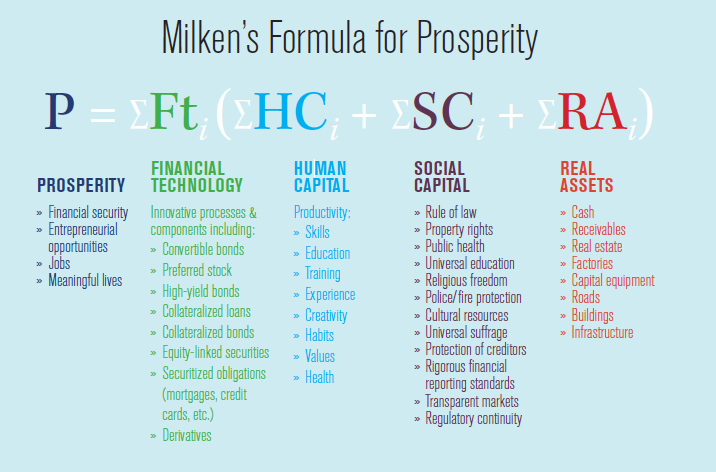
Soon he had developed an equation to explain the components of prosperity: P = Ft (HC + SC + RA). Prosperity equals the collective value of financial technologies acting to mul-tiply the total of human capital, social capital, and real assets. “Financial technology” includes innovative processes and components such as convertible bonds, preferred stock, high-yield bonds (also known as “junk bonds”), collateralized loans, equity-linked instruments, securitized obligations, and derivatives. “Human capital” is the collective talent, training, and experience of people as well as programs that increase the length and quality of life. “Social capital” includes—among other concepts—the rule of law, property rights, education, public health, and transparent markets. “Real assets” are tangible items on the balance sheet.
This prosperity formula later guided Milken’s work in financing thousands of companies that created millions of jobs. When major banks ran into problems in the early 1970s and turned off the lending spigot, he stepped forward and made capital available. As a 2008 New York Times article put it, “Mr. Milken helped create a new generation of companies and an entirely new way to finance nascent ideas that have helped fuel the global economy.”
Based on his studies of credit at Berkeley and of capital structure at the Wharton School, as well as his early practical experience on Wall Street, he provided financing for key industries such as cable, cellular, energy, health care, housing, media, private equity, telecommunications, and more.
BUILDING BUSINESSES
Unlike many financiers, Milken considered human capital to be part of any company’s balance sheet. And he emphasized future cash flow instead of “looking in the rearview mirror” at book value and reported earnings. He played this out by backing such pioneers as Eli Broad (real estate and finance), Dr. Armand Hammer (energy), Henry Kravis and George Roberts
(private equity), Carl Lindner (insurance), Craig McCaw (cellular telephones), Bill McGowan (telecommunications), John Malone (cable), Rupert Murdoch (media), Steven and Mitchell Rales (industrial), Leonard Riggio (book retailing), Steve Ross (entertainment distribution), Mel Simon (shopping malls), Bob Toll (home building), Ted Turner (cable networks), and Steve Wynn (resorts), among many other leaders of the companies he helped build. They earned his respect and backing because they had greater vision than the risk-averse managers who historically had counted on banks for financing.
Canada’s Globe and Mail newspaper called Milken’s financial innovations “one of the greatest achievements of modern capitalism.” He and his colleagues created what today’s business schools teach as a cornerstone of global finance. Previously, capital structure was essentially a binary world: investment-grade debt or equity. Milken created a broad spectrum of securities where risk could be matched to the needs of individual companies and investors. When Bloomberg Businesweek chose the 85 most important economic innovations of the past 85 years, the Milken revolution was 7th, ahead of DNA sequencing, Social Security, and email.
Moreover, because of his early experiences, barriers facing minority-owned businesses also began to fall. Milken funded Reginald Lewis, the first African-American to own a billion-dollar company, and Linda Wachner, the first woman to operate a Fortune 500 company without inheriting it. Media companies in the Hispanic market, such as Univision and Telemundo Group, grew and created jobs thanks to his financing.
THE MILKEN MYTHOLOGY
It’s often said that innovators get the arrows in their backs. That’s never been truer than in the case of Milken. Many appraisals of his career rely largely on myths. He has been compared to John D. Rockefeller, whose 19th-century business practices provided grist for the mill of muckraking journalists, and who was said to have “redeemed himself ” by good works after retiring from active management at Standard Oil. This comparison is flawed because Milken’s philanthropy began long before his visibility in the public media and developed in parallel with his business accomplishments. Like Rockefeller, Milken created a new business model for those who followed. But unlike Rockefeller, who concentrated on industrial power, Milken’s lifelong goal was just the opposite—he sought to “democratize capital.”
A 2014 book, Roy C. Smith’s The Money Wars, concluded that Milken is “the greatest financial genius this country has produced since J.P. Morgan.” One review of Smith’s book said of Milken, “Every now and then, an individual comes along at the right time and place in history who knows exactly where he or she is in that history, and leaves a world-historical footprint as a result.”
Milken’s “footprint” goes well beyond finance. In health and education philanthropy, he believes the same entrepreneurial approach that was so effective in business can have a powerful impact when it seeks out best practices and empowers people to change the world. It is never, he stresses, just about writing checks.
Some of the myths about Milken emerged during a brief period in his life during the late 1980s and early 1990s, when he was dealing with the immense strain of a legal battle that had become one of the 20th century’s most overwrought media events. Wall Street Journal columnist Holman Jenkins, echoing the view of many other observers, recently called it “a case that hasn’t stood the test of time.”
But 30 years ago, anti-business publications often attacked him for his role in mergers and acquisitions, which they claimed were eliminating jobs. These claims were not supported by facts. Some publications have tried to set the record straight: The Economist said Milken’s financial innovations “are credited with fueling much of America’s rampant economic growth by enabling companies with bright ideas to get the money they need to develop them,” adding, “This was a boon to the American economy.”
The mythology that grew up around him eventually took on a life of its own. In his introduction to Fenton Bailey’s 1992 book, Fall From Grace, Harvard Law School professor Alan Dershowitz admits that at first he “had been taken in” by the media stereotype. But after meeting Milken and conducting “a vast amount of research on the man,” Dershowitz wrote: “Old orders have never given up their reigns easily, whether they represented the Roman Empire, the British Empire or the Soviet ‘Empire’. Michael Milken was not part of the old order on Wall Street, with its strong ties to the government. Nor were most of the individuals whose ventures [he] helped finance. By being a visionary and an innovator, who lent his support to others of the same persuasion, and by being enormously successful at it, he provoked the wrath of the political and economic power structure.”


